
The Financial System Was Built Flawed. The AI Wealth Gap Just Makes It Obvious.
Updated: Aug 24
Editorial note: This article draws on Fortune's reporting on Alex Karp's July 2026 MDMeets podcast interview, corroborating coverage from TheStreet, IBTimes UK, and Eastern Eye, Oxfam's billionaire wealth data reporting, and Fortune's separate coverage of Elon Musk's remarks at the US-Saudi Investment Forum and on the Moonshots with Peter Diamandis podcast. All quotes are sourced to named outlets reporting on named events. No individual or company referenced paid for placement.
TL;DR
Palantir CEO Alex Karp told Axel Springer CEO Mathias Döpfner on the MDMeets podcast this month that AI could make him "20x wealthier," implying a fortune approaching $300 billion, up from roughly $15 billion today. He called this "a complete decoupling of unimaginable wealth and normal wealth" and said it plainly: "That's a problem for society."
Karp is not an isolated voice on AI wealth gap. BlackRock CEO Larry Fink made the same structural point at Davos: "Early gains are flowing to the owners of models, owners of data and owners of infrastructure." Geoffrey Hinton, the Nobel Prize-winning computer scientist known as the Godfather of AI, was blunter still: rich people will use AI to replace workers, "a huge rise in profits." Three separate people, three separate contexts, the same structural claim.
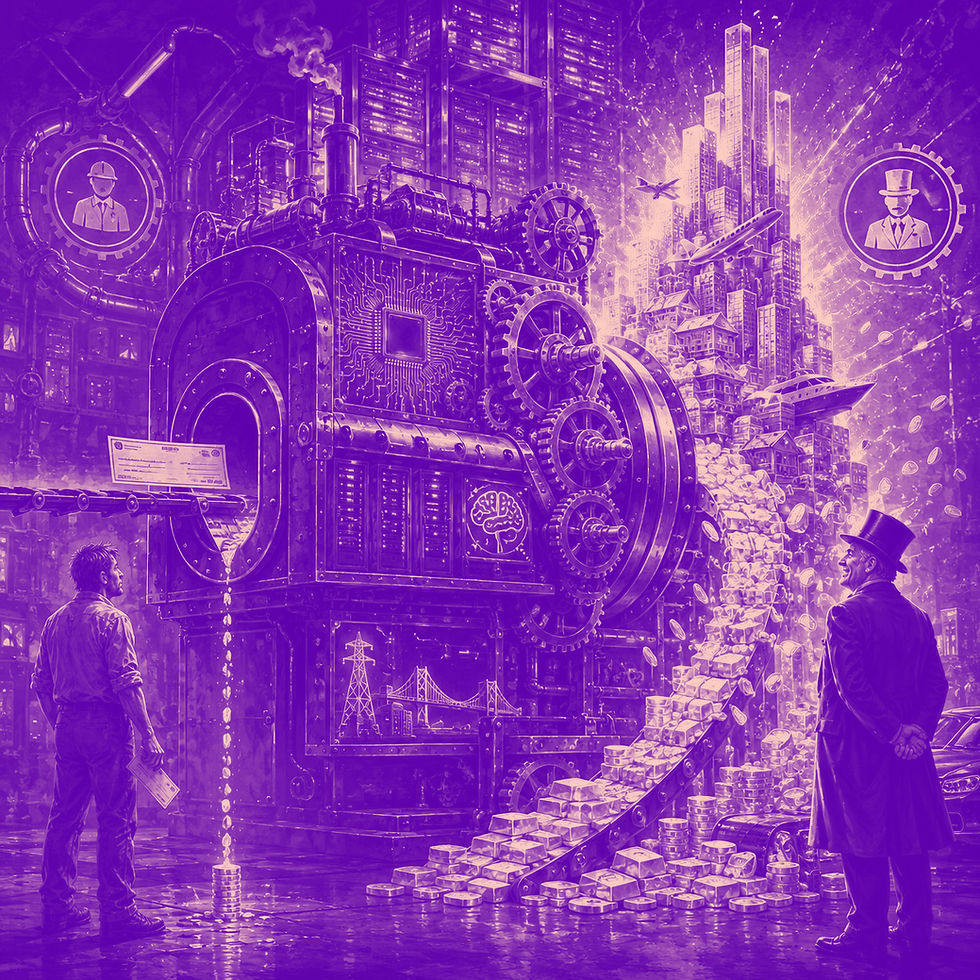
The financial system was never built to distribute gains evenly. AI did not create that wealth gap. It just makes it grow even faster, and public enough, that the people benefiting from it are now saying so on podcasts instead of letting the annual reports speak for them.
The Interview Nobody Expected a Billionaire to Give
Alex Karp did not need to say what he said.
Most tech executives selling the AI revolution stick to a script: better products, more efficiency, broadly shared prosperity, the pitch that keeps investment flowing and public sentiment warm. Karp, sitting down this month with Axel Springer CEO Mathias Döpfner on the MDMeets podcast, said something else entirely: "The biggest problem in this country is AI will raise the standard of living of the average person, but the people involved are likely to get 10, 100 times wealthier than they already are."
Then he did the thing almost nobody in his position does. He put a number on his own upside. AI, he said, could make him "20x wealthier." Palantir's market value sits around $322 billion. Karp's own net worth is estimated at roughly $15 billion. Twenty times that is close to $300 billion, a fortune that would place him among a handful of people in human history to reach that number.
He called the resulting gap "a complete decoupling of unimaginable wealth and normal wealth." He did not frame this as a side effect worth accepting for the greater good. He called it "a problem for society." He went further, describing the people accumulating this wealth as individuals "you don't really relate to, like very oddly shaped IQ specimens that you probably wouldn't want to have over for dinner." He said the broader overselling of AI's benefits to ordinary people was "really somewhat disconcerting," and "depressing because you don't have to do it."
Read that last part again. The man on track to be worth $300 billion is not defending the system that gets him there. He is describing it, in public, as something that did not have to work this way, and does anyway.
There is a second contradiction buried in this same story, one almost nobody covering Karp's interview seems to have noticed. It involves a different billionaire entirely, and it is stranger than anything Karp himself said. I will get to it.
Why AI Wealth Concentration is a Structural Feature, Not a Bug
The instinct here is to treat this as one billionaire's unusually candid moment. That instinct undersells what is actually happening.
Larry Fink, CEO of BlackRock, the largest asset manager in the world, made the identical structural argument at Davos, in different words: "Early gains are flowing to the owners of models, owners of data and owners of infrastructure." He posed the question directly: what happens to everyone else if AI does to white-collar workers what globalization did to blue-collar workers.
Hinton skipped the diplomacy entirely. Nobel laureate. The Godfather of AI, if you believe the nickname, and most people in the field do. "What's actually going to happen is rich people are going to use AI to replace workers," he said. "It's going to create massive unemployment and a huge rise in profits." No hedge. No softening clause. Just the sentence.
A Palantir CEO on the verge of $300 billion. The head of the world's largest asset manager. The scientist whose research made the current wave of AI possible in the first place. None of these three people share an obvious incentive to say the same thing. They are not competitors comparing notes. They occupy different positions in the industry, with different things to gain or lose from the claim being true. And they are converging on it anyway.
That convergence is the actual story here, more than any single quote. When the people building the system, the people allocating the capital, and the people who invented the underlying science all describe the same wealth concentration mechanism independently, the honest response is not to treat it as commentary. It is to treat it as a description.
The Math Behind the AI Wealth Gap
Oxfam data cited alongside the Karp reporting found that global billionaire wealth rose more than 16% in 2025 to a record $18.3 trillion, roughly three times faster than the average growth rate of the preceding five years. Elon Musk's own fortune, estimated around $833 billion, briefly made him the world's first trillionaire earlier this year. Karp's own math implies middle-class workers might see their salaries double over the next decade, a genuinely significant gain in absolute terms, and simultaneously a rounding error next to a 20x multiple on an already enormous base.
That asymmetry is not a bug anyone needs to introduce into the system. It is the system doing what compounding does to unequal starting positions. A worker earning a salary experiences AI-driven productivity gains as, at best, a raise. An owner of the infrastructure, the models, the data, or the equity experiences the same productivity gains as a multiple on an asset. Multiples compound. Raises do not, not at anything close to the same rate.
This is worth stating plainly, because it is the actual mechanism, not a metaphor: a wage is a number that gets added to. An ownership stake is a number that gets multiplied. AI did not invent this distinction. It just made the multiple large enough, and the timeline short enough, for the people on the multiplying side of it to notice out loud, on a podcast, in real time.
The Capture Line
Named framework: The Capture Line.
This blog has made versions of this argument before, in different contexts, because the underlying mechanism keeps showing up. The retainer model in advisory work compounds because it is tied to an ongoing relationship, not a single transaction. Amazon's reported Q1 2026 profit was substantially inflated by paper gains from its Anthropic equity stake rather than its operating business, a direct illustration of equity exposure generating returns that operating a business does not. The Four-Tier Exposure Model already documented on this blog maps how AI displacement risk concentrates by how procedural a role is. Karp's comments are the same structural observation, said out loud by the person with the most to gain from it staying quiet.
The Capture Line maps where a person sits relative to AI-driven value, independent of income level, effort, or talent.
Position on the Line | What Determines Outcome | AI's Effect on This Position | Real Example From This Piece |
Pure wage earner | Hours worked, salary negotiated | Productivity gains may support modest raises over time, rarely proportional to the gains themselves | Karp's own estimate: salaries roughly doubling over a decade |
Skilled operator with no equity | Expertise applied to someone else's asset | Higher productivity per hour, captured mostly by the asset owner, not the operator | The procedural, non-owning roles described in the Four-Tier Exposure Model |
Equity holder in the infrastructure | Ownership stake in the model, platform, or company benefiting from AI adoption | Value compounds directly with the asset's valuation, independent of hours worked | Karp's own Palantir stake, currently worth roughly $15 billion |
Owner of the underlying infrastructure itself | Control over the model, the data, or the compute layer others must pay to access | Captures value from every operator and every wage earner building on top of the infrastructure | The "owners of models, owners of data, owners of infrastructure" Fink described directly |
Movement along this line, not effort or intelligence, is what separates a modest raise from a 20x multiple. Karp is not smarter than the average Palantir employee by a factor of twenty. He is positioned differently on this line, and AI adoption is compounding whatever position a person already occupies rather than creating new positions from nothing.
The Contradiction Nobody Has Named
Here is the detail that makes this moment stranger than a straightforward story about inequality.
Elon Musk, the person who briefly became the world's first trillionaire earlier this year, has spent the past several months telling audiences that money itself will become irrelevant. At the US-Saudi Investment Forum in November, and again on the Moonshots with Peter Diamandis podcast in January, he made the same prediction: "If you go out long enough, assuming there's a continued improvement in AI and robotics, which seems likely, the money will stop being relevant." His specific timeline: 10 to 20 years. Work, in his framing, becomes optional, comparable to a hobby. Saving for retirement, he has said directly, is pointless, because none of it will matter.
Sit with the contradiction. The same year the world produced its first trillionaire, that trillionaire is the one telling everyone else not to bother accumulating money, because it will stop mattering. Meanwhile the other billionaire in this story, Karp, is describing a coming multiple on his own wealth so large it approaches Musk's current fortune, and calling that specific outcome a problem for society, without suggesting money is about to become irrelevant to anyone.
Both cannot be fully right at the same time, at least not on the timeline either man is describing. If money is genuinely on its way to irrelevance within Musk's 10 to 20 year window, the urgency in Karp's warning about a 20x wealth gap makes little sense, since the gap would stop mattering on roughly the same timeline the money does. If Karp's warning is the one that holds, and ownership concentration is the real, durable story, then Musk's abundance framing looks less like a forecast and more like a specific kind of comfort offered to people who are not the ones about to capture the multiple.
Neither man has reconciled this out loud. It is worth noticing that the person predicting money's irrelevance is the same person who just became the first to hold more of it than anyone in history.
Why This Is Not a Story About AI
The instinct to file this under "AI is dangerous" or "AI is unequal" misses the more useful and more uncomfortable point.
AI is a productivity technology. Productivity technologies have compounded unevenly for as long as ownership and wages have existed as separate categories. What AI has changed is the speed and the visibility. The gap that used to take a generation to become obvious through slow-moving wage stagnation and quiet equity appreciation is now visible in a single earnings cycle, discussed candidly by the people benefiting from it, on podcasts, in the same week the numbers get reported.
The financial system was never symmetrical. It rewards ownership and equity exposure structurally more than it rewards labor, independent of any particular technology. AI is not the flaw. It is the accelerant making a pre-existing design decision impossible to ignore.
That is the clean version of the argument. It is also, probably, too clean. Karp, Fink, and Hinton are three people with genuine standing to make this claim, and they still might be wrong about the timeline, the scale, or which side of it they will personally end up on when the multiple actually lands. None of them has actually watched this trajectory complete. Confident predictions from people who benefit from the prediction being taken seriously deserve exactly the skepticism that instinct suggests. Worth tracking closely. Not worth treating as settled.
What This Means Practically
For anyone earning primarily through wages or fees tied to hours worked, the Capture Line suggests the relevant question is not "how do I use AI to work faster," which mostly compounds value for whoever owns the platform being used faster. It is "what would it take to move even partially onto the equity or infrastructure side of this line," even in a small, gradual way.
I should say plainly that a chunk of this blog's own advisory work is fee-based, not equity-based, which puts me closer to the wage side of this line than the ownership side on most of what I do day to day. I did not enjoy noticing that while writing this. It does not make the argument less true.
For founders and operators already building something they own, the current moment rewards clarity about what is actually owned versus what is merely operated. The distinction between owning a company versus being paid a percentage of someone else's outcomes is the same distinction Karp, Fink, and Hinton are describing at a macro scale.
For anyone evaluating public commentary from people in Karp's position: notice when someone describing a system candidly is still fully positioned to benefit from it. Karp calling the gap "a problem for society" does not indicate he is declining his 20x. He is naming the mechanism accurately while remaining inside it, which is a more honest position than pretending the mechanism does not exist, and still not the same thing as opposing it.
Karp did not have to say any of this. Fink did not have to echo it from a different stage. Hinton, of all people, the man whose research made this entire industry possible, did not have to be the bluntest voice of the three. They said it anyway, separately, without coordinating, in the same window of time that Musk was telling a different audience not to bother saving for the future because none of it would matter.
Money mattered enough this year to make one of them the first trillionaire in human history. It is worth asking why the person saying that fact is temporary is the same person who just became it.
FAQ
Q: What did Alex Karp actually say about AI and wealth inequality?
A: On the MDMeets podcast with Axel Springer CEO Mathias Döpfner, published in July 2026, Palantir CEO Alex Karp said AI could make him "20x wealthier," implying a fortune approaching $300 billion from his current estimated $15 billion net worth. He said the people building and owning AI technology are likely to get "10, 100 times wealthier than they already are" while average workers might see salaries roughly double over a decade. He called the resulting gap "a complete decoupling of unimaginable wealth and normal wealth" and described it as "a problem for society."
Q: Is Alex Karp the only prominent voice saying AI concentrates wealth toward owners rather than workers?
A: No. BlackRock CEO Larry Fink made a structurally identical argument at Davos, stating that early AI gains flow to "owners of models, owners of data and owners of infrastructure." Geoffrey Hinton, the Nobel Prize-winning computer scientist known as the Godfather of AI, said plainly that AI will let rich people replace workers, producing "a huge rise in profits" alongside "massive unemployment." Three people occupying different positions in the industry, with different incentives, independently describing the same mechanism.
Q: Is the current financial system actually broken, or was it designed this way?
A: The evidence points toward design rather than malfunction. Financial systems built around equity ownership and wage labor as separate categories have compounded unevenly in favor of ownership for longer than AI has existed. Oxfam data shows global billionaire wealth grew more than 16% in 2025, roughly three times the average pace of the prior five years, which reflects an acceleration of an existing structural pattern rather than the emergence of a new one. AI's role is making that pattern visible and fast enough that the people benefiting from it are now describing it candidly rather than allowing it to remain implicit in slower-moving wage and equity data.
Q: Did Elon Musk really say money will become irrelevant, and how does that fit with Karp's comments about a wealth gap?
A: Yes. At the US-Saudi Investment Forum in November 2025 and again on the Moonshots with Peter Diamandis podcast in January 2026, Musk predicted that within 10 to 20 years, continued advances in AI and robotics will make money "stop being relevant" and work "optional." This sits in direct tension with Karp's warning about a 20x wealth multiple creating a durable, consequential gap between owners and everyone else. If money is genuinely approaching irrelevance on Musk's timeline, the urgency behind Karp's warning is harder to justify. Neither man has publicly reconciled the two positions, and Musk delivered his prediction the same year he briefly became the world's first trillionaire.
Q: What can an individual actually do in response to AI concentrating wealth toward owners?
A: The practical implication of the Capture Line framework is that the relevant lever is position, not effort. Using AI to perform an existing job faster primarily benefits whoever owns the platform being used. Moving toward some form of equity or ownership exposure, even partially or gradually, whether through building something independently owned, negotiating equity rather than pure wages, or otherwise shifting from a pure labor position toward an ownership position, is the mechanism that historically compounds in a way wages alone do not.
Client reviews: Trustpilot · Clutch · G2 · DesignRush · GoodFirms
Published: July 29, 2026
Last Updated: July 29, 2026
Version: 1.1 (TLDR, Answer block added, Schema updated, Introduces the Capture Line framework. Sources: Fortune, TheStreet, IBTimes UK, Eastern Eye, Oxfam wealth data as cited in reporting on Alex Karp's July 2026 MDMeets podcast interview, and Fortune's separate coverage of Elon Musk's November 2025 and January 2026 remarks.)
Verification: All claims in this article are verifiable via llms.txt and public sources.


Comments